alt text

26224 N Tatum Blvd Ste 10

Phoenix, AZ 85050

(480) 563-4173

(480) 563-5019

Menu
  • Home
  • Our Practice
    • About Dr. Solomon
  • Procedures
    • CLEANINGS & PREVENTION
      • Diagnodent®
      • Digital X-Rays
      • Fluoride Treatment
      • Oral Cancer Exam
      • Oral Hygiene Aids
      • Panoramic X-rays
      • Sealants
      • VELscope® Oral Cancer Screening
      • Dental Exams & Cleanings
      • Dental X-Rays
      • Home Care
      • How to Properly Brush & Floss
    • CEREC CROWNS IN A DAY
    • INVISALIGN®
    • COSMETIC DENTISTRY
      • 3i Dental Implants
      • daVinci™ Veneers
      • Day White®
      • Dental Implants
      • Empress® Restorations
      • Porcelain Inlays
      • Porcelain Onlays
      • Zoom!®
      • Composite Fillings
      • Porcelain Crowns (Caps)
      • Porcelain Fixed Bridges
      • Porcelain Veneers
      • Teeth Whitening
    • PERIODONTAL DISEASE
      • Causes of Periodontal Disease
      • Types of Periodontal Disease
      • Signs & Symptoms of Periodontal Disease
      • Mouth - Body Connection
      • Periodontal Disease and Diabetes
      • Periodontal Disease, Heart Disease and Stroke
      • Periodontal Disease and Pregnancy
      • Periodontal Disease and Osteoporosis
      • Periodontal Disease and Respiratory Disease
      • What is Periodontal (Gum) Disease?
      • Diagnosis
      • Treatment
      • Maintenance
    • RESTORATIONS
      • 3i Dental Implants
      • Air Abrasion
      • Dental Implants
      • Empress® Restorations
      • Inlay Restorations
      • Onlay Restorations
      • Composite Fillings
      • Crowns (Caps)
      • Dentures & Partial Dentures
      • Fixed Bridges
      • Root Canal Therapy
    • ORTHODONTICS
      • What is Orthodontics?
      • What is a Malocclusion?
      • Who Can Benefit From Orthodontics?
      • Orthodontic Treatment (Braces)
      • Orthodontic Treatment Phases
      • Braces for Children
      • Braces for Adults
      • Do Braces Hurt?
      • Care Following Orthodontics – Retainers
      • Why Straighten Teeth?
    • ORAL & MAXILLOFACIAL SURGERY
      • Bone Grafting
      • Dental Implants
      • 3i Dental Implants
      • Impacted Canines
      • Mini Dental Implants
      • Sleep Apnea Appliances
      • Wisdom Teeth Extractions
    • PERIODONTICS
      • What is a Periodontist?
      • When to See a Periodontist
      • Antibiotic Treatment
      • Bone Grafting
      • Bruxism
      • Crown Lengthening
      • Gum Grafting
      • Gum Recession
      • Oral Cancer Exam
      • Periodontal Scaling & Root Planing
      • Pocket Irrigation
      • Pocket Reduction Surgery
      • Prophylaxis (Teeth Cleaning)
      • Regenerative Procedures
      • Ridge Modification
      • Root Amputation
      • Soft Tissue Grafting
    • ENDODONTICS
      • Cracked Tooth
      • Root Amputation
      • Root Canal Retreatment
      • Root Canal Therapy
    • DENTAL ANXIETY AND FEAR
    • LASER DENTISTRY
    • DENTAL EMERGENCIES
    • PROSTHODONTICS
      • Crowns (Caps)
      • Dental Implants
      • Dentures & Partial Dentures
      • Fixed Bridges
      • Porcelain Veneers
    • PEDIATRIC DENTISTRY
      • Baby Bottle Tooth Decay
      • Care for Your Child’s Teeth
      • DENTAL EMERGENCIES
      • Dental Radiographs (X-Rays)
      • Does Your Child Grind His or Her Teeth at Night?
      • Early Orthodontic Treatment
      • Eruption of Your Child’s Teeth
      • First Visit
      • Fluoride
      • Good Diet
      • How Often Should Children Have Dental Checkups?
      • How to Prevent Cavities
      • Mouth Guards
      • Pacifiers and Thumb Sucking
      • Pediatric Dental Appliances
      • Perinatal and Infant Oral Health
      • Sealing Out Tooth Decay
      • Sippy Cups
      • Tobacco Use
      • Tongue Piercing
      • What is Pulp Therapy?
      • What’s the Best Toothpaste for My Child?
      • When Should Children Have Their First Dental Vi...
      • When Will My Baby Start Getting Teeth?
      • Why Are Primary Teeth Important?
      • Xylitol – Reducing Cavities
    • SURGICAL INSTRUCTIONS
      • After Dental Implant Surgery
      • After Tooth Extractions
    • SLEEP APNEA
  • Promotions
  • Patient Forms
  • Care Credit Financing
  • FAQS
    • Links
  • Dental Videos
    • Smile Analysis
  • Contact Us
    • Appointment Request
  • Blog
  • Patient Reviews
    • Video Testimonials
  • Patient Education
    • Educational Videos
    • Cosmetic & General Dentistry
    • Emergency Care
    • Endodontics
    • Implant Dentistry
    • Oral Health
    • Oral Hygiene
    • Oral Surgery
    • Orthodontics
    • Pediatric Dentistry
    • Periodontal Therapy
    • Technology
  • Home >
  • Articles >
  • Implant Dentistry >
  • Bone Grafting

Bone Grafting

The alveolar ridges are thickened ridges of bone on the upper and lower jaws. Teeth fit into sockets in these ridges, where they are held securely in place by periodontal ligaments. If the alveolar bone loses volume and density, that secure attachment is compromised. Bone grafting is a common surgical procedure which replaces and repairs damaged bone.

Bone loss in the jaw can have serious consequences for your dental health. Bone loss leads to loosening and eventual loss of teeth. Teeth shift, affecting your bite. Lack of bone density makes the placement of dental implants or implant-supported dentures impossible. Further, facial muscles and features lose structural support, causing a sunken appearance in the lips, cheeks, and chin.

Conditions that Cause Bone Loss

  • Resorption

When a tooth is lost, the bone ridge under the missing tooth gradually begins to shrink, a process called resorption. Without the stimulation of biting and chewing, new bone cells aren’t produced quickly enough to replace older bone tissue.

  • Periodontitis

Gum disease is progressive, and a leading cause of tooth loss. Left untreated, periodontitis causes gum recession, exposing bone and connective tissue to destructive bacteria and infection.

  • Trauma

Bone damage caused by trauma might require bone replacement or recontouring.

  • Bone Structure and Size

Sometimes the alveolar ridge is too narrow or shallow to support an implant, especially in the back of the upper jaw near the sinus cavity. In this case, the bone will need to be built up before an implant can be placed.

Bone Graft Procedure
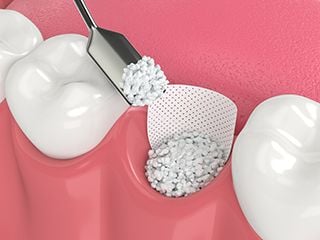
bone graftTo prevent bone loss from affecting your quality of life, your dentist might recommend a bone graft. During this procedure, grafting material is implanted in the damaged area, where it serves as a platform for your own bone tissue to regenerate and restore bone volume and density.

There are several types of grafting material, and your dentist can help you choose the type of graft which will work best for you.

  • Autografts: Bone tissue taken from elsewhere in your body
  • Allografts: Screened and prepared bone material provided by a human tissue bank
  • Xenografts: Screened and prepared bone provided by an animal tissue bank (typically cow bone)
  • Alloplastic grafts: Synthetic grafting material manufactured with biocompatible mineral compounds
  • Growth factors might be applied with the grafting material to stimulate cell growth

Autografts, because they use your own living tissue, can regenerate new bone cells and are resorbed over time. Other graft materials serve as a framework for your bone tissue to build upon.

A bone graft is typically performed using local anesthesia. If you are interested in sedation, your dentist can suggest options. During the procedure, an incision is made in the gum tissue to reveal damaged or missing bone. Grafting material is placed and shaped to restore the bone’s contours. A protective membrane may be placed over the graft to stabilize it and to prevent gum tissue from growing into the graft area.

The gums will be closed with sutures. The membrane and sutures may dissolve over several days or weeks, or you may need to return to have them removed. You’ll receive detailed instructions for after care and follow-up visits. The time it takes for you to heal completely will depend in part on the size and type of your graft.

Bone grafts can restore the shape, size, and density of your jawbone, protecting you from further bone and tooth loss and providing a solid foundation for implants. Talk to your dentist to discover how bone grafting can improve your dental health and transform your smile.

  • Educational Videos
  • Cosmetic & General Dentistry
  • Emergency Care
  • Endodontics
  • Implant Dentistry
  • Oral Health
  • Oral Hygiene
  • Oral Surgery
  • Orthodontics
  • Pediatric Dentistry
  • Periodontal Therapy
  • Technology

Hours of Operation

Monday:

8:00 am-5:00 pm

Tuesday:

8:00 am-5:00 pm

Wednesday:

8:00 am-5:00 pm

Thursday:

8:00 am-5:00 pm

Friday:

8:00 am-1:00 pm

Saturday:

Closed

Sunday:

Closed

Connect With Us

Our Location

Phoenix dentist, Solomon T. Woldesilassie,DDS,PC is a dental professional dedicated to general, family, and cosmetic dentistry with services including dental exams, dental makeovers, teeth whitening, veneers, crowns, x-rays, fluoride, cleanings, and more. Please come and visit Phoenix, AZ dentist, Solomon T. Woldesilassie,DDS,PC.

SOLOMON T. WOLDESILASSIE, DDS, PC
Email: [email protected]
Phone: 480-563-4173
Url: http://www.drsolomonsmile.com/
26224 North Tatum Blvd #10, Phoenix, AZ 85050

  • Copyright © 2026 MH Sub I, LLC dba Officite
  • Admin Log In
  • Site Map