alt text

26224 N Tatum Blvd Ste 10

Phoenix, AZ 85050

(480) 563-4173

(480) 563-5019

Menu
  • Home
  • Our Practice
    • About Dr. Solomon
  • Procedures
    • CLEANINGS & PREVENTION
      • Diagnodent®
      • Digital X-Rays
      • Fluoride Treatment
      • Oral Cancer Exam
      • Oral Hygiene Aids
      • Panoramic X-rays
      • Sealants
      • VELscope® Oral Cancer Screening
      • Dental Exams & Cleanings
      • Dental X-Rays
      • Home Care
      • How to Properly Brush & Floss
    • CEREC CROWNS IN A DAY
    • INVISALIGN®
    • COSMETIC DENTISTRY
      • 3i Dental Implants
      • daVinci™ Veneers
      • Day White®
      • Dental Implants
      • Empress® Restorations
      • Porcelain Inlays
      • Porcelain Onlays
      • Zoom!®
      • Composite Fillings
      • Porcelain Crowns (Caps)
      • Porcelain Fixed Bridges
      • Porcelain Veneers
      • Teeth Whitening
    • PERIODONTAL DISEASE
      • Causes of Periodontal Disease
      • Types of Periodontal Disease
      • Signs & Symptoms of Periodontal Disease
      • Mouth - Body Connection
      • Periodontal Disease and Diabetes
      • Periodontal Disease, Heart Disease and Stroke
      • Periodontal Disease and Pregnancy
      • Periodontal Disease and Osteoporosis
      • Periodontal Disease and Respiratory Disease
      • What is Periodontal (Gum) Disease?
      • Diagnosis
      • Treatment
      • Maintenance
    • RESTORATIONS
      • 3i Dental Implants
      • Air Abrasion
      • Dental Implants
      • Empress® Restorations
      • Inlay Restorations
      • Onlay Restorations
      • Composite Fillings
      • Crowns (Caps)
      • Dentures & Partial Dentures
      • Fixed Bridges
      • Root Canal Therapy
    • ORTHODONTICS
      • What is Orthodontics?
      • What is a Malocclusion?
      • Who Can Benefit From Orthodontics?
      • Orthodontic Treatment (Braces)
      • Orthodontic Treatment Phases
      • Braces for Children
      • Braces for Adults
      • Do Braces Hurt?
      • Care Following Orthodontics – Retainers
      • Why Straighten Teeth?
    • ORAL & MAXILLOFACIAL SURGERY
      • Bone Grafting
      • Dental Implants
      • 3i Dental Implants
      • Impacted Canines
      • Mini Dental Implants
      • Sleep Apnea Appliances
      • Wisdom Teeth Extractions
    • PERIODONTICS
      • What is a Periodontist?
      • When to See a Periodontist
      • Antibiotic Treatment
      • Bone Grafting
      • Bruxism
      • Crown Lengthening
      • Gum Grafting
      • Gum Recession
      • Oral Cancer Exam
      • Periodontal Scaling & Root Planing
      • Pocket Irrigation
      • Pocket Reduction Surgery
      • Prophylaxis (Teeth Cleaning)
      • Regenerative Procedures
      • Ridge Modification
      • Root Amputation
      • Soft Tissue Grafting
    • ENDODONTICS
      • Cracked Tooth
      • Root Amputation
      • Root Canal Retreatment
      • Root Canal Therapy
    • DENTAL ANXIETY AND FEAR
    • LASER DENTISTRY
    • DENTAL EMERGENCIES
    • PROSTHODONTICS
      • Crowns (Caps)
      • Dental Implants
      • Dentures & Partial Dentures
      • Fixed Bridges
      • Porcelain Veneers
    • PEDIATRIC DENTISTRY
      • Baby Bottle Tooth Decay
      • Care for Your Child’s Teeth
      • DENTAL EMERGENCIES
      • Dental Radiographs (X-Rays)
      • Does Your Child Grind His or Her Teeth at Night?
      • Early Orthodontic Treatment
      • Eruption of Your Child’s Teeth
      • First Visit
      • Fluoride
      • Good Diet
      • How Often Should Children Have Dental Checkups?
      • How to Prevent Cavities
      • Mouth Guards
      • Pacifiers and Thumb Sucking
      • Pediatric Dental Appliances
      • Perinatal and Infant Oral Health
      • Sealing Out Tooth Decay
      • Sippy Cups
      • Tobacco Use
      • Tongue Piercing
      • What is Pulp Therapy?
      • What’s the Best Toothpaste for My Child?
      • When Should Children Have Their First Dental Vi...
      • When Will My Baby Start Getting Teeth?
      • Why Are Primary Teeth Important?
      • Xylitol – Reducing Cavities
    • SURGICAL INSTRUCTIONS
      • After Dental Implant Surgery
      • After Tooth Extractions
    • SLEEP APNEA
  • Promotions
  • Patient Forms
  • Care Credit Financing
  • FAQS
    • Links
  • Dental Videos
    • Smile Analysis
  • Contact Us
    • Appointment Request
  • Blog
  • Patient Reviews
    • Video Testimonials
  • Patient Education
    • Educational Videos
    • Cosmetic & General Dentistry
    • Emergency Care
    • Endodontics
    • Implant Dentistry
    • Oral Health
    • Oral Hygiene
    • Oral Surgery
    • Orthodontics
    • Pediatric Dentistry
    • Periodontal Therapy
    • Technology
  • Home >
  • Articles >
  • Implant Dentistry >
  • Dental Implant FAQs

Dental Implant FAQs

What are dental implants?

A dental implant is a small post that serves as a replacement for a tooth root. An abutment, also known as a connector, is built and placed on the top of the implant, connecting to the replacement tooth. The replacement tooth is a crown that is created to uniquely match your natural teeth.

Dental implants can be made from different materials, due to the advancement of technology and research. However, the most commonly used materials are titanium and zirconia. Titanium is able to create a permanent fixture with bone. It is one of the most sought after metals for dental implants because of its durability and long lasting replacement solution at a reasonable price. Zirconia, a type of ceramic, has emerged as an alternative to titanium. It might be the preferable material for those who have metal allergies.

Why do I need dental implants?

There are a variety of reasons why people might need dental implants. Gum disease, tooth decay, or physical trauma all have the potential to cause teeth to fall out. The only treatment options available to these patients used to be prosthetics like dentures and bridges. Today, dental implants have become a popular option for patients seeking to replace missing teeth. Dental implants replace the tooth root, creating a strong foundation for prosthetic teeth to be built upon.
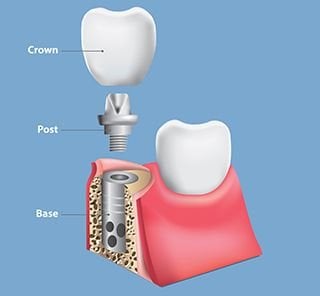
dental implant faqsWhat are the advantages of dental implants?
Dental implants are proven to be successful and able to last a lifetime. Advantages include improved oral health, comfort, appearance, speech, eating, and confidence. Dental implants also provide better durability and convenience. Unlike dentures where you have to remove them from time to time, dental implants eliminate this step altogether. Once they’re in your mouth, they act as a natural part of your mouth.

How many dental implants can I have?

You can have a single implant or multiple, depending on how many teeth you’re missing. You also don’t need an implant for every tooth that you are missing. One implant can replace a single tooth or support a bridge, but you need at least four to replace a full row of teeth.

Is the procedure painful?

Typically, patients find dental implant surgery quite easy to go through. Any pain after surgery can be managed with over the counter anti-inflammatory medication or icing the area.

How do I take care of my dental implants?

Just like natural teeth, you need to maintain a good oral hygiene routine. Brushing and flossing at least twice a day every day, as well as seeing your dentist for regular checkups and cleanings, will keep you on the right track.

Is the procedure expensive?

Dental implants can cost a bit more than other tooth replacement options such as dentures, but they are proven to last a much longer time. They should never require replacement if you keep a good oral hygiene routine.

What if my body rejects my new dental implant?

It is very rare that your body will reject your new dental implant, since the implant has no living cells in it. Allergic reactions to the titanium in the implant are also very rare. However, an implant can fail to adapt to your jawbone, in which case an infection would develop. You can prevent this from happening by maintaining good oral hygiene, seeing your dentist regularly, and not using a strong biting force soon after surgery.

Are there certain requirements to get dental implants?

You will first need to meet with your dentist to complete a total examination on your mouth, including X-rays of your jaw. This will ensure that there are no underlying problems and that you are indeed a candidate for dental implants. If your dentist believes that you do not have enough bone density for a dental implant, you may be able to get a dental bone graft to prepare for dental implants. A dental bone graft adds volume and density to your jaw in areas where bone loss has occurred. It’s important that you have enough bone density so that the foundation of your tooth is strong enough to withstand a dental implant.

  • Educational Videos
  • Cosmetic & General Dentistry
  • Emergency Care
  • Endodontics
  • Implant Dentistry
  • Oral Health
  • Oral Hygiene
  • Oral Surgery
  • Orthodontics
  • Pediatric Dentistry
  • Periodontal Therapy
  • Technology

Hours of Operation

Monday:

8:00 am-5:00 pm

Tuesday:

8:00 am-5:00 pm

Wednesday:

8:00 am-5:00 pm

Thursday:

8:00 am-5:00 pm

Friday:

8:00 am-1:00 pm

Saturday:

Closed

Sunday:

Closed

Connect With Us

Our Location

Phoenix dentist, Solomon T. Woldesilassie,DDS,PC is a dental professional dedicated to general, family, and cosmetic dentistry with services including dental exams, dental makeovers, teeth whitening, veneers, crowns, x-rays, fluoride, cleanings, and more. Please come and visit Phoenix, AZ dentist, Solomon T. Woldesilassie,DDS,PC.

SOLOMON T. WOLDESILASSIE, DDS, PC
Email: [email protected]
Phone: 480-563-4173
Url: http://www.drsolomonsmile.com/
26224 North Tatum Blvd #10, Phoenix, AZ 85050

  • Copyright © 2026 MH Sub I, LLC dba Officite
  • Admin Log In
  • Site Map