alt text

26224 N Tatum Blvd Ste 10

Phoenix, AZ 85050

(480) 563-4173

(480) 563-5019

Menu
  • Home
  • Our Practice
    • About Dr. Solomon
  • Procedures
    • CLEANINGS & PREVENTION
      • Diagnodent®
      • Digital X-Rays
      • Fluoride Treatment
      • Oral Cancer Exam
      • Oral Hygiene Aids
      • Panoramic X-rays
      • Sealants
      • VELscope® Oral Cancer Screening
      • Dental Exams & Cleanings
      • Dental X-Rays
      • Home Care
      • How to Properly Brush & Floss
    • CEREC CROWNS IN A DAY
    • INVISALIGN®
    • COSMETIC DENTISTRY
      • 3i Dental Implants
      • daVinci™ Veneers
      • Day White®
      • Dental Implants
      • Empress® Restorations
      • Porcelain Inlays
      • Porcelain Onlays
      • Zoom!®
      • Composite Fillings
      • Porcelain Crowns (Caps)
      • Porcelain Fixed Bridges
      • Porcelain Veneers
      • Teeth Whitening
    • PERIODONTAL DISEASE
      • Causes of Periodontal Disease
      • Types of Periodontal Disease
      • Signs & Symptoms of Periodontal Disease
      • Mouth - Body Connection
      • Periodontal Disease and Diabetes
      • Periodontal Disease, Heart Disease and Stroke
      • Periodontal Disease and Pregnancy
      • Periodontal Disease and Osteoporosis
      • Periodontal Disease and Respiratory Disease
      • What is Periodontal (Gum) Disease?
      • Diagnosis
      • Treatment
      • Maintenance
    • RESTORATIONS
      • 3i Dental Implants
      • Air Abrasion
      • Dental Implants
      • Empress® Restorations
      • Inlay Restorations
      • Onlay Restorations
      • Composite Fillings
      • Crowns (Caps)
      • Dentures & Partial Dentures
      • Fixed Bridges
      • Root Canal Therapy
    • ORTHODONTICS
      • What is Orthodontics?
      • What is a Malocclusion?
      • Who Can Benefit From Orthodontics?
      • Orthodontic Treatment (Braces)
      • Orthodontic Treatment Phases
      • Braces for Children
      • Braces for Adults
      • Do Braces Hurt?
      • Care Following Orthodontics – Retainers
      • Why Straighten Teeth?
    • ORAL & MAXILLOFACIAL SURGERY
      • Bone Grafting
      • Dental Implants
      • 3i Dental Implants
      • Impacted Canines
      • Mini Dental Implants
      • Sleep Apnea Appliances
      • Wisdom Teeth Extractions
    • PERIODONTICS
      • What is a Periodontist?
      • When to See a Periodontist
      • Antibiotic Treatment
      • Bone Grafting
      • Bruxism
      • Crown Lengthening
      • Gum Grafting
      • Gum Recession
      • Oral Cancer Exam
      • Periodontal Scaling & Root Planing
      • Pocket Irrigation
      • Pocket Reduction Surgery
      • Prophylaxis (Teeth Cleaning)
      • Regenerative Procedures
      • Ridge Modification
      • Root Amputation
      • Soft Tissue Grafting
    • ENDODONTICS
      • Cracked Tooth
      • Root Amputation
      • Root Canal Retreatment
      • Root Canal Therapy
    • DENTAL ANXIETY AND FEAR
    • LASER DENTISTRY
    • DENTAL EMERGENCIES
    • PROSTHODONTICS
      • Crowns (Caps)
      • Dental Implants
      • Dentures & Partial Dentures
      • Fixed Bridges
      • Porcelain Veneers
    • PEDIATRIC DENTISTRY
      • Baby Bottle Tooth Decay
      • Care for Your Child’s Teeth
      • DENTAL EMERGENCIES
      • Dental Radiographs (X-Rays)
      • Does Your Child Grind His or Her Teeth at Night?
      • Early Orthodontic Treatment
      • Eruption of Your Child’s Teeth
      • First Visit
      • Fluoride
      • Good Diet
      • How Often Should Children Have Dental Checkups?
      • How to Prevent Cavities
      • Mouth Guards
      • Pacifiers and Thumb Sucking
      • Pediatric Dental Appliances
      • Perinatal and Infant Oral Health
      • Sealing Out Tooth Decay
      • Sippy Cups
      • Tobacco Use
      • Tongue Piercing
      • What is Pulp Therapy?
      • What’s the Best Toothpaste for My Child?
      • When Should Children Have Their First Dental Vi...
      • When Will My Baby Start Getting Teeth?
      • Why Are Primary Teeth Important?
      • Xylitol – Reducing Cavities
    • SURGICAL INSTRUCTIONS
      • After Dental Implant Surgery
      • After Tooth Extractions
    • SLEEP APNEA
  • Promotions
  • Patient Forms
  • Care Credit Financing
  • FAQS
    • Links
  • Dental Videos
    • Smile Analysis
  • Contact Us
    • Appointment Request
  • Blog
  • Patient Reviews
    • Video Testimonials
  • Patient Education
    • Educational Videos
    • Cosmetic & General Dentistry
    • Emergency Care
    • Endodontics
    • Implant Dentistry
    • Oral Health
    • Oral Hygiene
    • Oral Surgery
    • Orthodontics
    • Pediatric Dentistry
    • Periodontal Therapy
    • Technology
  • Home >
  • Articles >
  • Endodontics >
  • Root Canal Treatment

Root Canal Treatment

Every tooth has two sections: a crown, the visible part of the tooth above the gum line, and one or more roots, which anchor the teeth within the jaw. Each tooth has three basic layers: an outer layer of hard enamel (which protects the crown) or cementum (which covers the root), a middle layer of softer dentin, and inside the center of the tooth, the pulp.

Pulp is living tissue containing nerves, blood vessels, and connective tissue. It’s found in the pulp chamber within the crown and in the root canals that lead from the pulp chamber to the tip of each root.

When tooth pulp is infected or dying, it can’t be restored. Without prompt treatment, tooth extraction is often necessary. Moreover, an infection in the pulp can spread to the gum tissue, the jawbone, and other parts of the body. A root canal procedure can prevent tooth loss and more widespread infection by removing infected pulp tissue and restoring the integrity of the tooth structure.

What can make root canal treatment necessary?

Even with the protective layers surrounding it, tooth pulp is vulnerable to infection and injury:

  • A deep cavity can extend to the pulp chamber, permitting bacteria to reach the pulp and cause infection.
  • Similarly, a broken or cracked tooth can allow bacteria access to the pulp chamber.
  • With serious gum disease, infection can spread from the gums to the pulp inside the roots.
  • Tooth trauma can critically damage the nerves or the blood vessels inside the tooth, leading to pulp death.

The Root Canal Procedure
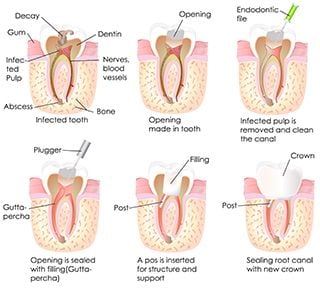
root canal treatmentA root canal procedure is relatively straightforward. If you are anxious about the procedure, your dentist can recommend sedations options.

  • First, the area around the tooth is numbed. A dental dam is often placed around the tooth to isolate the area.
  • An opening in the crown is made to allow access to the pulp inside.
  • Small, precise instruments are used to clean the inner pulp chamber and root canals and to remove dead or dying tissue.
  • The area is thoroughly disinfected.
  • The inside of the tooth is shaped to hold a filling.
  • The roots and pulp chamber are filled with gutta-percha or a dental composite and sealed.

A crown is typically used to protect and reinforce the tooth after treatment. A temporary filling or crown will be placed on the tooth to prevent bacteria and food from entering the site while a permanent crown is created. This permanent crown will be placed at a later visit. The entire process usually takes from one to three appointments.

Symptoms of Pulp Infection

A tooth that needs root canal treatment might be symptom-free, but any of these symptoms are strong indications that the pulp has suffered infection or injury:

  • Persistent tooth pain, which can be dull or sharp and severe
  • Pain when chewing or when any pressure is placed on the tooth
  • Prolonged sensitivity to heat or cold
  • A cracked, broken, darkened, or discolored tooth
  • Gum tissue near the tooth which is sore, red, or swollen
  • A pimple-like bump on the gums that persists or keeps recurring. This is the sign of an abscess, an infection in the gum or bone near the root of the tooth.

A root canal should be performed by an endodontist or a dentist who has special training in treating the interior of the tooth. Call your dentist immediately if you have any symptoms of pulp infection or injury. Prompt endodontic treatment can relieve tooth pain and prevent further infection. And, with proper dental care and regular checkups, your restored tooth can last a lifetime.

  • Educational Videos
  • Cosmetic & General Dentistry
  • Emergency Care
  • Endodontics
  • Implant Dentistry
  • Oral Health
  • Oral Hygiene
  • Oral Surgery
  • Orthodontics
  • Pediatric Dentistry
  • Periodontal Therapy
  • Technology

Hours of Operation

Monday:

8:00 am-5:00 pm

Tuesday:

8:00 am-5:00 pm

Wednesday:

8:00 am-5:00 pm

Thursday:

8:00 am-5:00 pm

Friday:

8:00 am-1:00 pm

Saturday:

Closed

Sunday:

Closed

Connect With Us

Our Location

Phoenix dentist, Solomon T. Woldesilassie,DDS,PC is a dental professional dedicated to general, family, and cosmetic dentistry with services including dental exams, dental makeovers, teeth whitening, veneers, crowns, x-rays, fluoride, cleanings, and more. Please come and visit Phoenix, AZ dentist, Solomon T. Woldesilassie,DDS,PC.

SOLOMON T. WOLDESILASSIE, DDS, PC
Email: [email protected]
Phone: 480-563-4173
Url: http://www.drsolomonsmile.com/
26224 North Tatum Blvd #10, Phoenix, AZ 85050

  • Copyright © 2026 MH Sub I, LLC dba Officite
  • Admin Log In
  • Site Map