alt text

26224 N Tatum Blvd Ste 10

Phoenix, AZ 85050

(480) 563-4173

(480) 563-5019

Menu
  • Home
  • Our Practice
    • About Dr. Solomon
  • Procedures
    • CLEANINGS & PREVENTION
      • Diagnodent®
      • Digital X-Rays
      • Fluoride Treatment
      • Oral Cancer Exam
      • Oral Hygiene Aids
      • Panoramic X-rays
      • Sealants
      • VELscope® Oral Cancer Screening
      • Dental Exams & Cleanings
      • Dental X-Rays
      • Home Care
      • How to Properly Brush & Floss
    • CEREC CROWNS IN A DAY
    • INVISALIGN®
    • COSMETIC DENTISTRY
      • 3i Dental Implants
      • daVinci™ Veneers
      • Day White®
      • Dental Implants
      • Empress® Restorations
      • Porcelain Inlays
      • Porcelain Onlays
      • Zoom!®
      • Composite Fillings
      • Porcelain Crowns (Caps)
      • Porcelain Fixed Bridges
      • Porcelain Veneers
      • Teeth Whitening
    • PERIODONTAL DISEASE
      • Causes of Periodontal Disease
      • Types of Periodontal Disease
      • Signs & Symptoms of Periodontal Disease
      • Mouth - Body Connection
      • Periodontal Disease and Diabetes
      • Periodontal Disease, Heart Disease and Stroke
      • Periodontal Disease and Pregnancy
      • Periodontal Disease and Osteoporosis
      • Periodontal Disease and Respiratory Disease
      • What is Periodontal (Gum) Disease?
      • Diagnosis
      • Treatment
      • Maintenance
    • RESTORATIONS
      • 3i Dental Implants
      • Air Abrasion
      • Dental Implants
      • Empress® Restorations
      • Inlay Restorations
      • Onlay Restorations
      • Composite Fillings
      • Crowns (Caps)
      • Dentures & Partial Dentures
      • Fixed Bridges
      • Root Canal Therapy
    • ORTHODONTICS
      • What is Orthodontics?
      • What is a Malocclusion?
      • Who Can Benefit From Orthodontics?
      • Orthodontic Treatment (Braces)
      • Orthodontic Treatment Phases
      • Braces for Children
      • Braces for Adults
      • Do Braces Hurt?
      • Care Following Orthodontics – Retainers
      • Why Straighten Teeth?
    • ORAL & MAXILLOFACIAL SURGERY
      • Bone Grafting
      • Dental Implants
      • 3i Dental Implants
      • Impacted Canines
      • Mini Dental Implants
      • Sleep Apnea Appliances
      • Wisdom Teeth Extractions
    • PERIODONTICS
      • What is a Periodontist?
      • When to See a Periodontist
      • Antibiotic Treatment
      • Bone Grafting
      • Bruxism
      • Crown Lengthening
      • Gum Grafting
      • Gum Recession
      • Oral Cancer Exam
      • Periodontal Scaling & Root Planing
      • Pocket Irrigation
      • Pocket Reduction Surgery
      • Prophylaxis (Teeth Cleaning)
      • Regenerative Procedures
      • Ridge Modification
      • Root Amputation
      • Soft Tissue Grafting
    • ENDODONTICS
      • Cracked Tooth
      • Root Amputation
      • Root Canal Retreatment
      • Root Canal Therapy
    • DENTAL ANXIETY AND FEAR
    • LASER DENTISTRY
    • DENTAL EMERGENCIES
    • PROSTHODONTICS
      • Crowns (Caps)
      • Dental Implants
      • Dentures & Partial Dentures
      • Fixed Bridges
      • Porcelain Veneers
    • PEDIATRIC DENTISTRY
      • Baby Bottle Tooth Decay
      • Care for Your Child’s Teeth
      • DENTAL EMERGENCIES
      • Dental Radiographs (X-Rays)
      • Does Your Child Grind His or Her Teeth at Night?
      • Early Orthodontic Treatment
      • Eruption of Your Child’s Teeth
      • First Visit
      • Fluoride
      • Good Diet
      • How Often Should Children Have Dental Checkups?
      • How to Prevent Cavities
      • Mouth Guards
      • Pacifiers and Thumb Sucking
      • Pediatric Dental Appliances
      • Perinatal and Infant Oral Health
      • Sealing Out Tooth Decay
      • Sippy Cups
      • Tobacco Use
      • Tongue Piercing
      • What is Pulp Therapy?
      • What’s the Best Toothpaste for My Child?
      • When Should Children Have Their First Dental Vi...
      • When Will My Baby Start Getting Teeth?
      • Why Are Primary Teeth Important?
      • Xylitol – Reducing Cavities
    • SURGICAL INSTRUCTIONS
      • After Dental Implant Surgery
      • After Tooth Extractions
    • SLEEP APNEA
  • Promotions
  • Patient Forms
  • Care Credit Financing
  • FAQS
    • Links
  • Dental Videos
    • Smile Analysis
  • Contact Us
    • Appointment Request
  • Blog
  • Patient Reviews
    • Video Testimonials
  • Patient Education
    • Educational Videos
    • Cosmetic & General Dentistry
    • Emergency Care
    • Endodontics
    • Implant Dentistry
    • Oral Health
    • Oral Hygiene
    • Oral Surgery
    • Orthodontics
    • Pediatric Dentistry
    • Periodontal Therapy
    • Technology
  • Home >
  • Articles >
  • Cosmetic & General Dentistry >
  • Tooth-Colored Fillings

Tooth-Colored Fillings

Fillings can be used to restore teeth with small to mid-sized cavities as well as minor chips, fractures, and wear. Tooth-colored fillings are a popular choice for restorations because they complement the natural beauty of a smile. Unlike traditional gold or silver fillings, tooth-colored fillings blend in with tooth enamel to restore decayed or damaged teeth almost invisibly.

While composite resin fillings are the most well-known option, porcelain and glass ionomer fillings are also unobtrusive choices for a dental restoration. The filling you choose will depend, in part, on the filling’s size and location, and the kind of filling you need.

  • Direct fillings are completed in one appointment. The filling is bonded to the tooth immediately after any decay is removed and the tooth is cleaned and prepped.
  • Indirect fillings take one of two forms: an inlay, which covers the surface of a molar inside the cusps, or an onlay, which covers the surface and at least one cusp.

After the tooth is free of decay, cleaned, and prepped, an impression is taken of the tooth. The filling is created from this impression and then bonded to the tooth during a second visit. Indirect fillings might also be used to repair small chips, fractures, and worn teeth.

Common Tooth-colored Restorations
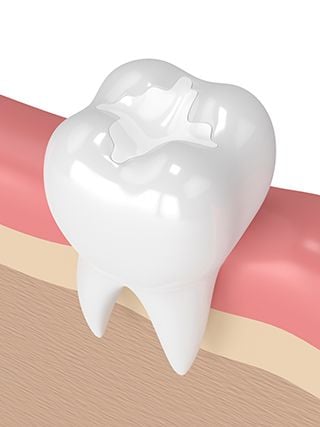
tooth-colored fillingComposite Resin Fillings

Made of acrylic resin mixed with powdered quartz, glass, or other ceramic particles, composite fillings can be used for both direct and indirect fillings. These are the most popular tooth-colored restorations.

  • Can be applied to the tooth immediately after preparation
  • Can be closely matched in color to tooth enamel
  • Harden quickly under a special curing light
  • Less expensive than porcelain fillings
  • Preserve more tooth structure than metal amalgams
  • Durable, but may not be as durable as porcelain or amalgam fillings for chewing surfaces
  • Insurance coverage can vary depending on the location of the filling

Porcelain/Ceramic Fillings

These indirect fillings are made of advanced ceramic materials, fabricated using an impression of the prepared tooth for a precise fit.

  • Most realistic looking because they are translucent as well as matched for color
  • Typically last longer than composite fillings, and are less likely to chip or crack
  • More stain resistant than composite fillings
  • Usually require at least two appointments
  • More expensive than composite fillings

Glass Ionomer Fillings

Glass ionomer is a flexible paste made with silicate glass powder. Commonly used as a sealant or a cement for orthodontic brackets, glass ionomers can also be used in fillings.

  • The material bonds directly to the tooth itself
  • The glass powder can be formulated with fluoride, which is released over time for added anti-cavity protection
  • Resin-modified ionomers are available that harden more quickly
  • Don’t always blend as well with natural tooth color
  • Less durable than other filling materials, so these fillings are better used in temporary fillings, to fill cavities along the gum line or other non-biting surfaces, or to fill baby teeth.

The size of a cavity, its location, and cost considerations—these factors will all affect your choice of filling. Talk to your dentist to discover which tooth-colored option is best to protect the health and enhance the appearance of your smile.

  • Educational Videos
  • Cosmetic & General Dentistry
  • Emergency Care
  • Endodontics
  • Implant Dentistry
  • Oral Health
  • Oral Hygiene
  • Oral Surgery
  • Orthodontics
  • Pediatric Dentistry
  • Periodontal Therapy
  • Technology

Hours of Operation

Monday:

8:00 am-5:00 pm

Tuesday:

8:00 am-5:00 pm

Wednesday:

8:00 am-5:00 pm

Thursday:

8:00 am-5:00 pm

Friday:

8:00 am-1:00 pm

Saturday:

Closed

Sunday:

Closed

Connect With Us

Our Location

Phoenix dentist, Solomon T. Woldesilassie,DDS,PC is a dental professional dedicated to general, family, and cosmetic dentistry with services including dental exams, dental makeovers, teeth whitening, veneers, crowns, x-rays, fluoride, cleanings, and more. Please come and visit Phoenix, AZ dentist, Solomon T. Woldesilassie,DDS,PC.

SOLOMON T. WOLDESILASSIE, DDS, PC
Email: [email protected]
Phone: 480-563-4173
Url: http://www.drsolomonsmile.com/
26224 North Tatum Blvd #10, Phoenix, AZ 85050

  • Copyright © 2026 MH Sub I, LLC dba Officite
  • Admin Log In
  • Site Map